Wednesday, March 2, 2011

Notes from Feb 27th Conference

Presented by: R. Sharath Jois
27-Feb-2011
Gokulum, Mysore India

VEGETARIAN DIET
Sharath spoke about the importance of a vegetarian diet for the purpose of better health and ahimsa (non-harming). He quoted one of Guruji’s favorite Ayurvedic mantras about the importance of eating ghee to sharpen the brain, milk to increase lifespan, and fresh food to feel fresh. Humans are designed to be vegetarians because if you look at our teeth we have “cow teeth, we don’t have tiger or lion teeth, we are not meant to eat meat.” He commented how in his experience, meat eaters are angry people whereas people who eat sattvic food are very calm. He also joked about how chappatis (in moderation) are the key to lifting up in uth pluthi and to avoid garlic since it has strong effects on your exhale in doing drop backs!

A recipe from Sharath for increasing your strength:
* Soak mung beans in a copper bowl over night
* In the morning add jaggary to the mix
* blend it up for a smoothie
* drink after your morning asana practice.

QUESTIONS AROUND ASANA PRACTICE
  1. The sweat produced in asana practice is beneficial to the body to rub back into the skin and joints. The toxins released will not re-enter the body, only the beneficial minerals.
  2. Cow’s urine is medicinal, in the olden days people drank a concoction of the five fruits of the cow –urine, milk, ..., ...and poo (Sharath giggled when he said the word poo.) He also said that nowadays if someone gives it to you to drink, you fake drink it and throw it over your shoulder.
  • Changes happen inside asana work. Toxins come out. Temporary fever, diarrhea, etc are all natural and part of the purification process. Someone asked “what if I do not sweat during practice?” and Sharath replied to do the practice faster. It should not be too slow or too fast. Each person has to find the right pace for him/herself. The practice is designed to be followed by the breath, what Sharath calls “free breathing.” This is not ujaii breath, which is an advanced pranayama. Free breathing, which is what we should be practicing during asana is a full and deep inhale and exhale which are equal in length. This type of full breathing removes the toxins in the body via apanavayu. A lengthened breath leads to a lengthened life.
  • People who practice yoga using tristhana will remove toxins and have beautiful skin, a “yoga glow.” In contrast, people who just do the physical feats like circus performers, will look weathered and old, like circus performers.
  • There are a prescribed count and breaths to the Ashtanga yoga asana series, but Sharath gave permission for extra breaths in harder postures.
  • The teacher should be like honey. Honey is in the flower. The bee comes to the honey. Not the other way around. Guruji never advertised. Sharath recommended teachers not to promote themselves.
  • A question was asked whether/when to meditate and Sharath reminded that meditation is control of all sense organs, and that it is better for us to refine sukham sthiram in asana work. Urban life is challenging for meditation, asana is best performed in the morning from 4:30am-6:30am when it is more peaceful, the air is more full of pure oxygen, and the mind will be most calm.

ASHTANGA YOGA SYSTEM
A question was asked whether it is more challenging to practice in such a large group because of the distraction and perhaps competition that arises. Sharath warned people not to compete with others. “You should only compete with yourself, with your ego, your desires, etc. Nowadays there are so many material challenges, rarely does someone challenge themselves spiritually.” He continued “to practice yoga, you should love asana, you should love spirituality, you should love your practice, whatever it is, and (with a smile on his face) you should enjoy suffering also!” … “You must also be intelligent. There is a wide variety of things out there that people are calling yoga. You must know what it is so you can explain it properly to people. Yoga means to join. To join jivatma (soul/self) and paratma (God). You must realize the divine inside of you. Purify yourself with yoga in order to be closer to divine. And understand that purity! There are eight limbs or steps: yama, niyama, asana, pranayama, pratyahara, dharana, dhyana and samadhi. The practice is designed perfectly. Follow it step-by-step. Asana alone does not make you a yogi. A yogi is one who is pure. Follow all eight limbs.”

half-way point


I'm past my half-way point, but thought I'd mark it anyway. I've definitely settled into a routine of EARLY morning meditation and asana practice, breakfast, painting , chanting, lunch/dinner, meditation, and EARLY bedtime. the reason I stress early is because the alarm goes off at 3:30am on most days and 2:30am on Fridays and Sundays. Sometimes I wonder if this is really a vacation :)
The first picture is Jen giving coconut water to one of our local shala dogs (the dogs that meet & greet us in the wee early hours before and after practice.) This one (im not sure if she has a name) likes to make sure im focused in my meditation by licking my palms and sniffing my face!


This is me on my scooter which I drive into town for painting (below) and chanting. Some people may think its a crazy place to drive, but I find it the best place for two-wheelers since almost everybody is on one and the speeds do not exceed 30mph. Its a bit crowded on the road, but there is a collective consciousness which allows for organized chaos.


I must also HIGHLY recommend my chanting teacher to anyone interested. His name is James Boag and if you're not in Mysore, he will be touring the US and Europe this year. He is currently getting his MA in Sanskrit here in Mysore and leads Kirtan and Bhagavad Gita. He has a very special gift of song, story telling, and teaching which he so generously shares with us four days a week. His info and current Mysore schedule is as follows:

James Boag
tel:959 113 5031 email:jamesrboag@gmail.com

Kirtan: Wednesdays and Sundays: 1:30-3:30pm
There is often a short talk on a theme related to yoga at the beginning or end.

Gita/Philosophy class: Tuesdays and Thursdays: 1:00-3:30pm
All welcome, it does not matter if you have not attended previous classes. Some very beautiful sloka-s and we will recite and translate.

A note from James...
"One of the engagements I am particularly looking forward to is the Telluride Yoga Festival, 14-17 July.

There are two complementary themes for this summer's festival in Telluride, bhakti and vinyasa, and I expect to speak on how they are related in the keynote address which I will give on the Sunday. I'm also looking forward to offering three themed kirtan sessions, combining a talk developing an aspect of yoga theory/philosophy and the practice of kirtan. There are some very well-respected teachers presenting at the conference and a wide and to my mind quite balanced and interesting offering of classes. I know that for many of you Colorado might be hard to get to this July, but if you might be in the area, it would be wonderful to see you there. Registration for the conference is open and you can sign up via the festival website. If you would like to register, I understand that if you give 'James 2011' as a 'promotional code' you are entitled to a modest discount.

Before Colorado, I will hopefully give some talks and kirtan in the New York area, and after will be working with Paul Millage in the Seattle area offering a series of classes, themed kirtans and a weekend retreat. Apart from Telluride and Seattle, the exact itinerary is yet to be finalized, that should all take shape once my exam dates have been announced, hopefully by the end of this month.

Apart from in the US, I'm also hoping to offer some talks, kirtans and workshops in Spain, Germany, Italy, Romania and England, maybe Prague too, will send out relevant information once dates and venues are confirmed."

Thursday, February 24, 2011

Painting update


So Ive added another painting to my list. It is of Gayathri. I learned her mantra and its constantly in my head. Tomorrow Ill go buy a book on this elusive goddess who's been running through my head.

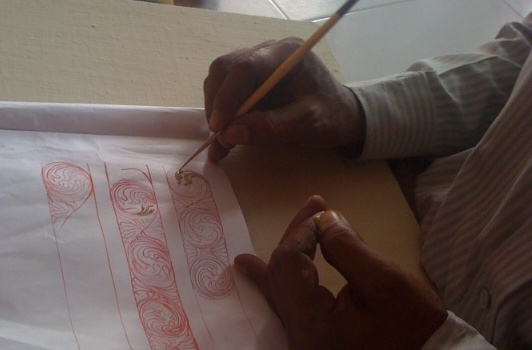
The Traditional Mysore style of painting includes gold embossing. So i have been busy this week first adding the embossing (painting on a cement like substance in various shapes and patterns) and then gluing on solid gold leaf (very fine and very tricky). Here are Vishnu and Gayathri in beginning phases...

Thursday, February 17, 2011

Mysorepedia by Claudia


My good friend Claudia (who was one of my roommates on my first trip to India) is a fabulous blogger with a of information on Mysore, Ashtanga and more.. Please check out her blog its excellent!

A few of my favorites so far are her article on why its so hard to meditate (maybe its because I am mentioned in it :) and the article her husband wrote on how foreign this yoga world is to an outsider.
(click on the highlighted words to open these links)


Claudia, it was so great to see you again!! Jen and I miss you & and invite you to visit Michigan!!

Have you ever seen a goat waiting for a bus?


There's many animals I see daily that I don't regularly see at home. I take the bus into town for my painting class and the other day there was a goat happily perched on the bench. We human passengers allowed him this spot, and his friend even come along with him to enjoy sitting in the shade.

Cows roam the streets freely and will even take a brake to park on the side.

In the residential area where homes have lots of greenery and flowers you'll find monkeys.

There's lots of dogs (who I do see and very much miss at home) but here there are many stray dogs and even puppies!

Tuesday, February 15, 2011

Hyderabad weekend

Jen and I were invited by Dr and Mrs Reddy to Hyderabad for the weekend. I could not imagine more gracious hosts. They showed us around the city, took us to parties and even a wedding!


First we went to Charminar in the center of the city. "Char" means four and "minar" means tower. There was a really short, narrow, winding, solid stone staircase to the top and the guide told me multiple times to watch my head. Luckily, I did not hit my head.

Next we went to Chowmahalla Palace. "Chow" also means four and "mahalla" means palace, so this was amazing grounds with four palaces, gardens, fountains and gorgeous artifacts.


The Reddy's also took us to a family wedding. A traditional Indian wedding with all the rituals and 1000 guests - yes, one thousand guests! I got this gown specially made for me and the tailor laughed because the measuring tape wasn't long enough for me!


There was a central park next to our hotel with a great walking path, open spaces for people practicing yoga and morning exercises and roaming peacocks!

Wednesday, February 9, 2011

Anita's breakfast

For breakfast one morning, Anita made us a traditional dish called "Upma" Its made from ground wheat and spices. The first picture shows the ingredients (and this is how she cooks, its not just for presentation) onions, potato, chillies, mustard seeds, black gram dal, bengal gram dal, curry leaves (picked from our backyard) coriander leaves and shaved coconut for garnish.

The first seven ingredients
are simmered in hot oil for
5-10min, then water is added.


Next the ground wheat (which was toasted prior to this) is added and simmered on low until it soaks up the all the flavored moisture.
Then the garnish of coconut and coriander is placed in the bottom of a small bowl, the Upma is placed on that, then you flip it upside down onto the plate. Yumm!!